Weighted Mean Calculator
Enter values with their weights — percentages or plain numbers — and get the weighted average with every multiplication shown.
What is a weighted mean?
A weighted mean is an average in which some values count more than others. Each value is multiplied by its weight — a number saying how much it should count — before the average is taken. Course grades are the everyday case: a final exam worth 50% of the grade should move your average more than a homework set worth 20%, and the weighted mean is the arithmetic that does exactly that. GPA, weighted test scores, portfolio returns and survey results (where some respondents represent more people) all run on the same idea.
Weighted mean formula
Multiply each value x by its weight w, add those products, then divide by the sum of the weights.
The division by Σw is what makes the weights flexible: they can be percentages (20, 30, 50), decimals (0.2, 0.3, 0.5) or plain counts (2, 3, 5). Only the proportions matter.
How to calculate a weighted mean
Worked example — a course grade built from homework 90 (weight 20%), quizzes 84 (30%) and a final exam 78 (50%):
Step 1 — Multiply each value by its weight. 90 × 0.2 = 18 · 84 × 0.3 = 25.2 · 78 × 0.5 = 39.
Step 2 — Add the products. 18 + 25.2 + 39 = 82.2.
Step 3 — Divide by the sum of the weights. The weights sum to 1 (100%), so the weighted mean is 82.2 ÷ 1 = 82.2. The steps panel above builds this same table for your rows.
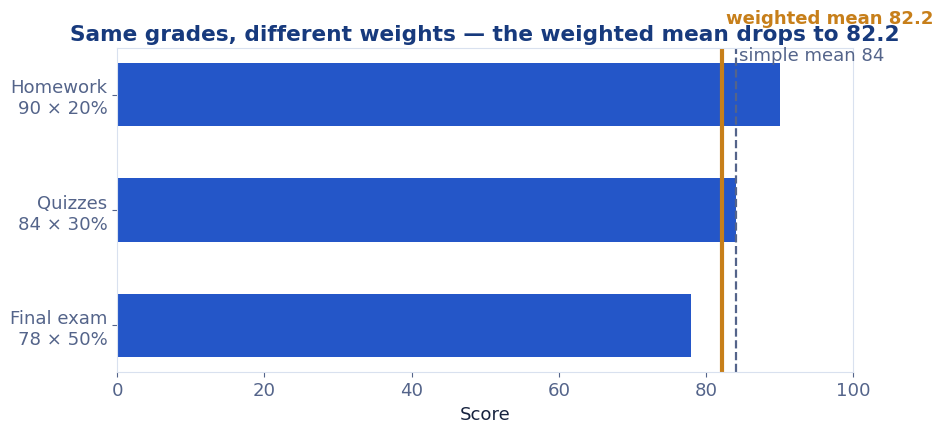
Weighted vs simple mean
The simple mean of 90, 84 and 78 is 84 — it pretends the final exam counts the same as the homework. The weighted mean, 82.2, is lower because the weakest score carries the heaviest weight. Whenever components are worth different amounts — different credit hours, different stakes, different sample sizes — the simple mean quietly lies and the weighted mean is the honest figure. The reverse mistake is just as common: averaging two class averages without weighting by class size. Our weighted average guide and the mistakes guide both work that trap in full.
Weighted grades and GPA
A GPA is a weighted mean where the values are grade points (A = 4.0, B = 3.0…) and the weights are credit hours. A 4-credit course moves the average twice as much as a 2-credit course at the same grade. Enter grade points as values and credits as weights in the calculator above to reproduce any semester by hand, or follow how to calculate your GPA for the full semester-plus-cumulative method.
Weighted means beyond grades
The same machinery runs anywhere importance varies. Investments: a portfolio holding 70% bonds returning 3% and 30% stocks returning 9% has a weighted return of (0.7 × 3) + (0.3 × 9) = 4.8% — not the naive 6%. Surveys: if young voters are under-sampled, their responses are weighted up so the published average represents the electorate rather than the sample. Price indices: inflation baskets weight rent far above cinema tickets because households spend more on rent. Combining groups: merging two classes' averages requires weighting by class size — the single most common weighted-mean mistake in the wild, dissected in our mistakes guide. In every case the formula is unchanged: multiply by importance, add, divide by total importance.
Frequently asked questions
How is a weighted mean different from a regular mean?
A regular mean treats every value equally. A weighted mean multiplies each value by its weight first, so important values count more.
Do the weights have to add up to 100%?
No. The calculator divides by the sum of the weights, so weights of 2, 3 and 5 work exactly like 20%, 30% and 50%.
What is the weighted mean of 90, 84 and 78 with weights 20%, 30%, 50%?
(90 × 0.2) + (84 × 0.3) + (78 × 0.5) = 18 + 25.2 + 39 = 82.2.
Can I mix percentage and plain-number weights?
Yes — type a % after a weight to mark it as a percentage (20% is treated as 0.2), or leave weights as plain numbers. As long as the weights are in the same proportion, the answer is identical.
Is GPA a weighted mean?
Yes. Grade points are the values and credit hours are the weights, which is why a 4-credit A lifts your GPA more than a 2-credit A. Our GPA guide works a full semester by hand.