Mean Examples
Full worked solutions to the exact sets students ask about — each with its sum, count and division shown, and the pattern that makes some of them instant.
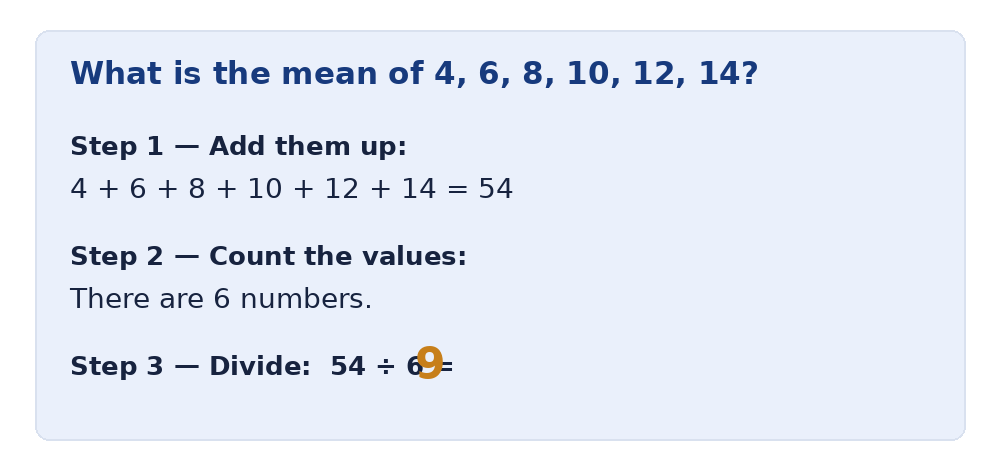
What is the mean of 4, 6, 8, 10, 12, 14?
Add them up: 4 + 6 + 8 + 10 + 12 + 14 = 54. Count them: 6. Divide: 54 ÷ 6 = 9. The mean is 9 — which is also the median here, because the set is evenly spaced. Worked sets like this one fill the rest of the page; the method never changes.
What is the mean of 3, 5, 7, 9, 11, 13, 15?
Sum: 3 + 5 + 7 + 9 + 11 + 13 + 15 = 63. Count: 7. Mean: 63 ÷ 7 = 9. Again the answer is the middle value itself — the odd numbers from 3 to 15 are an arithmetic sequence, and the mean of an arithmetic sequence is always its centre.
What is the mean of 78, 85, 92, 85, 90, 76, 85, 94?
These are the test scores used across this site. Sum: 685. Count: 8. Mean: 685 ÷ 8 = 85.625. Not a whole number, and not a value anyone scored — both completely normal for a mean. The median of the same set is 85 and the mode is 85; the mean calculator shows all three with their steps.
What is the mean of 1, 2, 2, 9?
Sum: 1 + 2 + 2 + 9 = 14. Count: 4. Mean: 14 ÷ 4 = 3.5. The median is 2 and the mode is 2 — a small set with a big lesson: the single large value (9) pulls the mean above every other value in the set. When that happens, the median usually describes the "typical" value better.
Spot the pattern
Both of the most-searched sets above are evenly spaced (arithmetic sequences), and both average exactly to their middle. That is a theorem, not luck: in an arithmetic sequence, the values pair symmetrically — first + last equals second + second-to-last — so the total is the middle value times the count, and the division hands the middle straight back. For an even count, the mean is the average of the middle pair (which is also the median). Use it as a shortcut and as a check: if a set is evenly spaced and your calculated mean is not the middle, the arithmetic slipped somewhere.
Try your own numbers
Every set follows the same three steps — count, add, divide — set out in how to calculate the mean. Paste your set into the mean calculator and you will get the answer with each of those steps written out for your exact numbers, plus the median, mode, range and standard deviation alongside.
More guides
Frequently asked questions
What is the mean of 4, 6, 8, 10, 12, 14?
The sum is 54 and the count is 6, so the mean is 54 ÷ 6 = 9.
What is the mean of 3, 5, 7, 9, 11, 13, 15?
The sum is 63 and the count is 7, so the mean is 63 ÷ 7 = 9.
Why do evenly spaced sets average to the middle?
In an arithmetic sequence the values pair up symmetrically around the centre — smallest + largest = second + second-to-last = twice the middle — so the mean lands exactly on the middle value (or the average of the middle pair).
How can I find the mean of my own set?
Add the values, divide by how many there are — or paste the set into the mean calculator at the top of this site and read the answer with its steps.