Common Mean Calculation Mistakes
Averaging averages, phantom zeros, silently deleted outliers, wrong denominators and early rounding — the five errors behind most wrong means, with fixes.
The mistakes that matter
The mean formula is three steps long, yet the same five errors produce most wrong answers — in homework, in spreadsheets, and in published reports. Each one below comes with the fix. The mean calculator is built to make several of them impossible; the rest are habits worth building by hand.
Mistake 1: Averaging averages
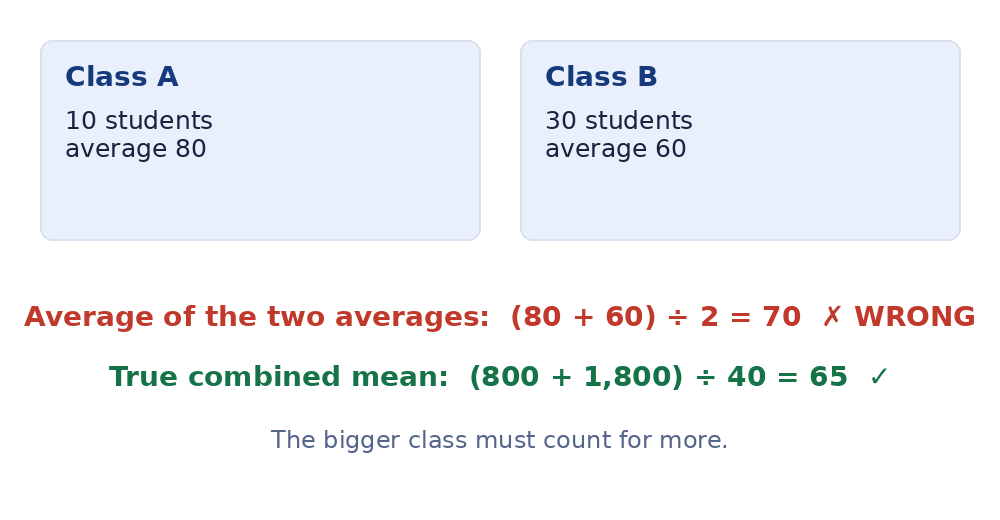
A class of 10 students averages 80 on a test. Another class of 30 averages 60. What is the combined average? The tempting answer — (80 + 60) ÷ 2 = 70 — is wrong. Averages cannot be averaged unless the groups are the same size, because the second class carries three times the students. Go back to totals: class A scored 10 × 80 = 800 points in total; class B scored 30 × 60 = 1,800. Combined: (800 + 1,800) ÷ 40 = 65. The fix is always the same: reconstruct the sums, add them, divide by the total count — or use the weighted mean calculator with the group sizes as weights.
Mistake 2: Counting blanks as zeros
Paste a spreadsheet column containing an empty cell into a careless tool and the empty cell becomes a 0 — a score nobody earned, dragging the mean down and inflating the count. The same trap hides in raw lists: a trailing comma, a dash standing in for "no data", a label typed into a number column. The defence is a count check: compare the number of values the calculation used with the number you expected. Every calculator on this site reports its Count, and skips non-numbers instead of zeroing them.
Mistake 3: Dropping outliers silently
Removing the owner's $240,000 salary turns a mean of $69,166.67 into a tidy $35,000 — and an honest report into a misleading one. Outliers are data, not dirt. If a value is provably an error (a typo, a broken sensor), remove it and say so. If it is genuine, keep it and quote the median next to the mean. The judgment framework is in what is an outlier?
Mistake 4: Wrong denominators
The divisor n is the number of values, counting every duplicate every time it appears. Sets described by frequency tables cause the classic version: three rows with frequencies 2, 3, 5 are ten values, and dividing by 3 (rows) instead of 10 (Σf) wrecks the answer. The frequency table guide drills this one specifically.
Mistake 5: Rounding too early
Round once, at the end. Rounding each value first, or rounding the running sum, injects small errors that compound across a long list — a mean reported as 85.4 that should be 85.6 usually died this death. Keep full precision through the division, then round the final answer to the precision the audience needs (one decimal for most reports; the calculators here show up to four).
More guides
Frequently asked questions
What is the most common mean mistake?
Averaging averages — combining two group means without weighting by group size. Two classes averaging 80 (10 students) and 60 (30 students) combine to 65, not 70.
Why does a blank cell change the mean?
Only if a tool counts it as zero. A phantom zero adds a fake value and drags the mean down. This site's calculators ignore blanks entirely and report the Count used.
Should I remove outliers before calculating the mean?
Only if you can show the value is an error — and even then, say what you removed and why. Silently deleting a genuine extreme value makes the mean tidy and the report dishonest.
When should I round the mean?
At the very end, once. Rounding intermediate values — or the sum — compounds into a visibly wrong answer on longer lists.