Mean vs Median
How outliers and skewed data pull the mean away from the typical value — and when the median is the honest answer.
The one-sentence difference
The mean is the total divided by the count — every value contributes, including the extremes. The median is the middle value of the sorted data — the extremes affect it only by existing, never by how extreme they are. Everything else in this guide is that sentence playing out on real data. Both are computed side by side, from one paste, by the mean calculator.
When they agree
Take the test scores 78, 85, 92, 85, 90, 76, 85, 94. The mean is 85.625 and the median is 85 — nearly identical, because the scores are fairly symmetric: no freak values, no long tail. In data like this the two measures tell the same story and either can be quoted. Agreement between mean and median is itself a useful signal: it says the distribution is balanced.
When they disagree (skew and outliers)
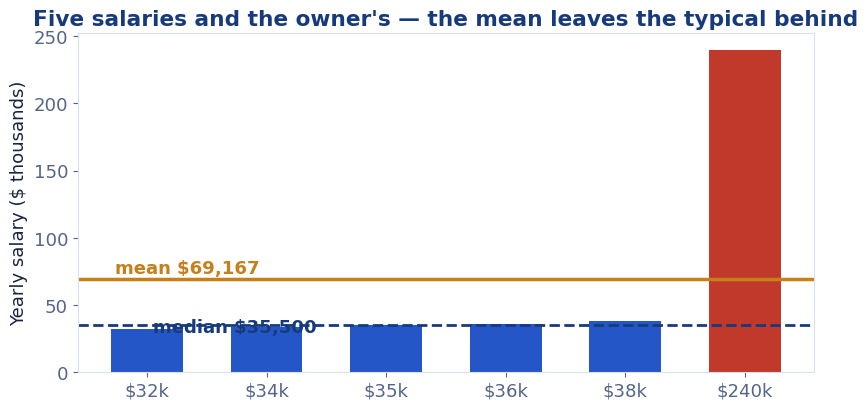
Now the salaries: $32,000, $34,000, $35,000, $36,000, $38,000 — and the owner at $240,000. The mean is $69,166.67, more than anyone except the owner earns. The median is $35,500, the average of the two middle salaries, and an honest description of a typical salary at the company. One extreme value out of six moved the mean by tens of thousands and the median by nothing at all. Data with a long tail of big values (incomes, house prices, company sizes) is called right-skewed, and it is exactly the data where quoting the mean alone misleads. A long tail of small values skews the other way and drags the mean below the median.
Income and house prices — why medians headline
Official statistics almost always quote medians for money. A street with nine modest houses and one mansion has a mean price that describes none of them; the median price is the middle house, full stop. National statistics offices report median household income for the same reason — a handful of billionaires would otherwise "raise" the average income in a way no household experiences. When a headline does quote a mean income, it is worth asking why. Our explainer on what an outlier is shows how to detect the values responsible.
Which to use — decision table
| Situation | Use | Why |
|---|---|---|
| Test scores, temperatures, measurements | Mean | Data is even; every value carries information |
| Salaries, house prices, waiting times | Median | Skewed data; the mean would misdescribe the typical case |
| Further statistics planned (SD, z-scores) | Mean | Later methods are built on the mean |
| Data with errors or freak values you cannot verify | Median | One bad value cannot move it |
| Any report that matters | Both | The gap between them describes the skew |
To find the median of your own data with the sorted working shown, use the median calculator. For the three-way comparison including the mode, see mean, median and mode compared.
More guides
Frequently asked questions
What is the one-sentence difference between mean and median?
The mean shares the total equally among all values; the median is simply the middle value when the data is sorted.
Which is better for salaries, mean or median?
The median. A few very large salaries drag the mean far above what a typical person earns, while the median reports the person in the middle.
Can the mean and median be the same?
Yes — in roughly symmetric data they often coincide. When they differ sharply, the data is skewed and the median is usually the safer headline.
Which one should I use in a report?
Quote the median when the data is skewed, and mention the mean alongside it. The gap between the two is itself useful information about the shape of the data.