How to Calculate Your GPA
Letter grades to grade points, weighted by credit hours — a full semester worked by hand, plus cumulative and weighted GPA explained.
The 4.0 scale
| Letter grade | A+ | A | A− | B+ | B | B− | C+ | C | C− | D | F |
|---|---|---|---|---|---|---|---|---|---|---|---|
| Grade points | 4.0 | 4.0 | 3.7 | 3.3 | 3.0 | 2.7 | 2.3 | 2.0 | 1.7 | 1.0 | 0.0 |
Scales vary slightly between schools (some cap A+ at 4.0, as here; some award 4.3) — use your own school's table for official figures. A GPA is a weighted mean: grade points are the values, credit hours are the weights. The weighted mean calculator will run the arithmetic for any set of courses.
Grade points × credit hours
The method, in three moves: (1) convert each grade to points; (2) multiply by that course's credit hours — the product is called quality points; (3) divide the total quality points by the total credit hours.
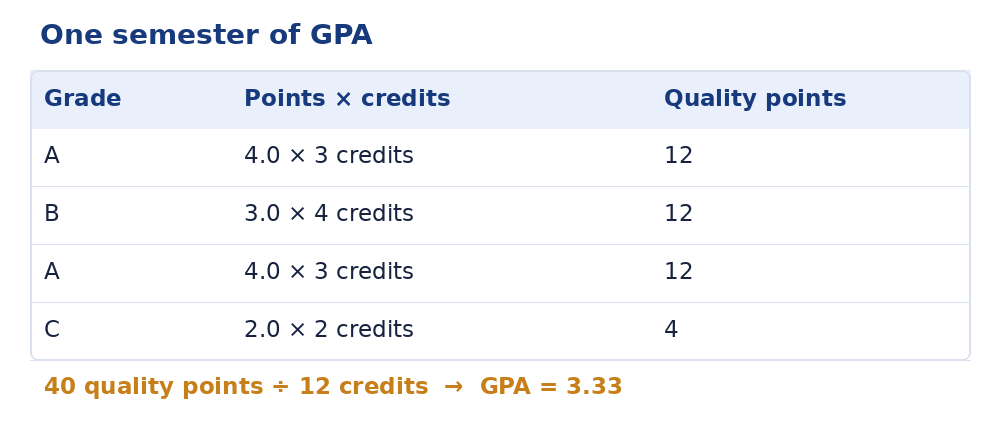
Worked semester
- Course 1: A (4.0) × 3 credits = 12 quality points
- Course 2: B (3.0) × 4 credits = 12 quality points
- Course 3: A (4.0) × 3 credits = 12 quality points
- Course 4: C (2.0) × 2 credits = 4 quality points
Total quality points = 40. Total credits = 12. GPA = 40 ÷ 12 ≈ 3.33. Notice the 4-credit B and the 3-credit A contribute equally (12 each) — credits decide influence as much as grades do, which is why a bad grade in a heavy course is so hard to dilute.
Cumulative GPA
Cumulative GPA pools everything: add the quality points from every term and divide by the credits from every term. The common error is averaging semester GPAs — a 3.8 semester of 9 credits and a 3.2 semester of 15 credits do not average to 3.5; pooled properly, they are (34.2 + 48) ÷ 24 ≈ 3.43. This is the averaging-averages trap in academic dress; the weighted average guide explains the mechanics behind it.
Unweighted vs weighted GPA
"Unweighted" GPA uses the plain 4.0 scale for every course — the system above. "Weighted" GPA (a different use of the word) adds a bonus for advanced courses — an A in an AP or honours class might be worth 5.0 — to reward harder schedules. The two scales are not comparable across schools, and colleges typically recompute both on their own rules. Either way, the engine underneath is the same weighted mean.
Raising a GPA: the maths of recovery
Students often ask how much one strong semester can move a cumulative GPA. The weighted mean answers precisely. Suppose you hold a 3.0 across 60 completed credits — that is 180 quality points banked. A 15-credit semester at a perfect 4.0 adds 60 points, giving (180 + 60) ÷ 75 = 3.20. The same semester at 3.5 yields (180 + 52.5) ÷ 75 = 3.10. Two lessons hide in the arithmetic: new credits move the average by their share of the new total (15 of 75 = 20% of the way toward the new semester's GPA), and the more credits you have banked, the heavier each further point becomes to earn. Run your own scenario in the weighted mean calculator — banked points as one row, the target semester as another.
More guides
Frequently asked questions
How do you calculate GPA?
Convert each letter grade to grade points (A = 4.0, B = 3.0, C = 2.0, D = 1.0, F = 0.0), multiply by the course's credit hours, add everything, and divide by the total credit hours.
What GPA is 40 quality points over 12 credits?
40 ÷ 12 = 3.33 — the worked semester in this guide.
How is cumulative GPA different from semester GPA?
The semester GPA covers one term; the cumulative GPA pools every term — total quality points across all terms divided by total credits across all terms. Never average the semester GPAs directly unless the terms carry equal credits.
What is weighted GPA?
Some schools add a bonus for honours or AP courses (an A worth 5.0 instead of 4.0). That scale varies by school — the arithmetic (a weighted mean) is identical.