How to Calculate the Mean
The formula, three steps, and worked examples for every kind of data set — plain numbers, decimals, negatives, times and frequency tables.
The mean formula
Σx means "add up all the values"; n is how many values there are.
The mean — the ordinary "average" — is the total of a data set shared out equally among its values. Every method in this guide is that one idea applied carefully: to decimals, to negatives, to times, and to data that arrives in frequency tables. If you would rather have the arithmetic done for you — with the steps still shown — the mean calculator does exactly this working on any pasted list.
Step by step with an example
Eight students scored 78, 85, 92, 85, 90, 76, 85, 94 on a test. Find the mean score.
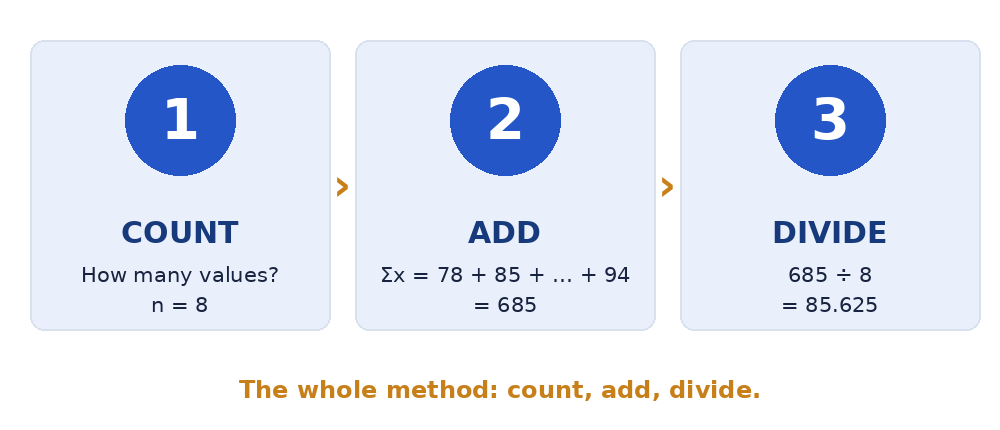
Step 1 — Count the values. There are 8 scores, so n = 8. Write the count down first; most mean errors are really counting errors.
Step 2 — Add up all the values. 78 + 85 + 92 + 85 + 90 + 76 + 85 + 94 = 685. On long lists, add in pairs or groups and check the total a second way (smallest-to-largest, say) — the sum is where slips hide.
Step 3 — Divide the sum by the count. 685 ÷ 8 = 85.625.
Step 4 — Sanity-check. A mean must fall between the smallest (76) and largest (94) values, and usually near the middle of the pack. 85.625 passes both checks. If your answer falls outside the min–max range, the arithmetic — not the data — is wrong.
Finding the mean of decimals and negatives
Nothing about the method changes. Decimals: add carefully, keeping decimal places aligned — the mean of 2.5, 3.5 and 4.6 is 10.6 ÷ 3 ≈ 3.53. Negatives: the same, watching signs — the mean of −4, 2 and 8 is 6 ÷ 3 = 2, and the mean of temperatures −6, −2, 0 and 4 is −4 ÷ 4 = −1. A negative mean is a perfectly good answer when the data straddles zero. The one rule that survives every variation: the count n is always the number of values, never the number of distinct values.
Averaging times (the "mean calculator for time" problem)
Times break naive averaging because hours and minutes are not decimal. The fix: convert everything to the smallest unit, average, convert back. Three runs take 1 h 20 min, 1 h 40 min and 2 h. In minutes that is 80, 100 and 120. The mean is (80 + 100 + 120) ÷ 3 = 100 minutes = 1 hour 40 minutes. Working in seconds is identical and safer for times with a seconds part. Never average "1.20" and "1.40" as decimals — 1 h 20 min is not 1.2 hours.
The mean from tables and grouped data
When values arrive with frequencies — three students scored 70, five scored 80 — multiply each value by its frequency, add the products, and divide by the total frequency: that is the Σf·x ÷ Σf method, worked in full in our frequency table guide and automated in the mean calculator with frequency. Grouped classes (0–10, 10–20…) use class midpoints the same way, and give an estimate rather than an exact mean.
Common mistakes
- Counting blanks as zeros — an empty cell is not a 0; it is nothing, and including it drags the mean down.
- Averaging averages — combine totals, not averages (see the mistakes guide for the classroom proof).
- Rounding mid-calculation — keep full precision until the final answer.
- Dividing by the wrong n — duplicates count every time they appear; a value that occurs three times is three values.
More worked sets — including the exact "what is the mean of…" questions students search for — are collected in mean examples.
More guides
Frequently asked questions
How do you calculate a mean?
Count the values, add them all up, and divide the total by the count. For 78, 85, 92, 85, 90, 76, 85, 94: the sum is 685, the count is 8, and 685 ÷ 8 = 85.625.
What is the formula for the mean?
x̄ = Σx ÷ n — the sum of all values (Σx) divided by the count (n). For a population the same calculation is written μ = Σx ÷ N.
How do you average times, like race times?
Convert each time to the smallest unit (minutes or seconds), average those numbers, then convert back. Times of 80, 100 and 120 minutes average to 100 minutes — 1 hour 40 minutes.
Can the mean of whole numbers be a decimal?
Yes — 85.625 is the mean of eight whole-number test scores. The mean is a balance point, not a data point, so decimals are normal.