Mean Absolute Deviation Explained
The average distance from the mean, in plain English — the four-step method, the canonical 1-to-5 example, and how MAD compares with standard deviation.
What MAD measures
The mean tells you where a data set is centred; it says nothing about how tightly the values hug that centre. The mean absolute deviation (MAD) fills the gap with one friendly number: on average, how far is each value from the mean? A class with a mean score of 80 and a MAD of 3 is a consistent class; the same mean with a MAD of 18 is a class of extremes wearing an average as camouflage. The MAD calculator computes it with the deviation table shown; this guide is the concept and the by-hand method.
MAD in four steps
Mean first; then each value's distance from the mean (minus signs ignored); then the mean of those distances.
Step 1 — Find the mean of the data set. Step 2 — Subtract the mean from every value. Step 3 — Drop the minus signs (absolute values), so distances are positive. Step 4 — Average the distances.
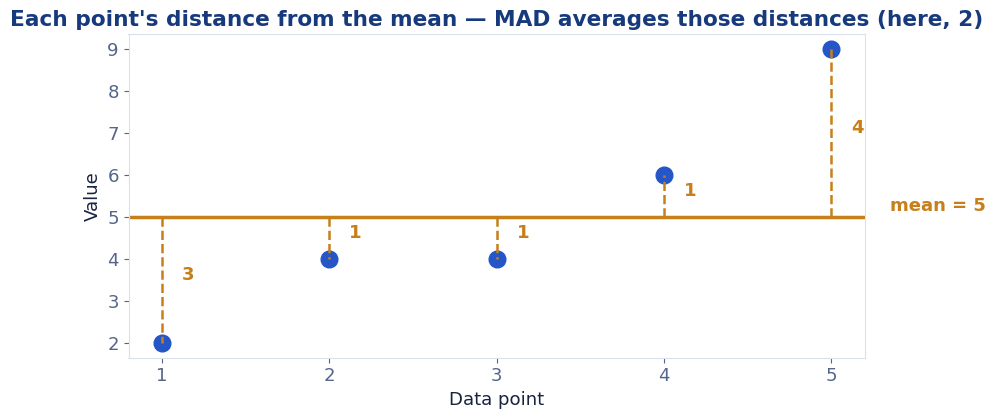
Worked example
The set 1, 2, 3, 4, 5: the mean is 15 ÷ 5 = 3. Distances from 3: |1 − 3| = 2, |2 − 3| = 1, |3 − 3| = 0, |4 − 3| = 1, |5 − 3| = 2. Sum of distances = 6. MAD = 6 ÷ 5 = 1.2. Read it literally: the values in this set sit, on average, 1.2 units away from their mean. This is the canonical classroom set behind the question students search for — "what is the mean absolute deviation of 1, 2, 3, 4, 5?" — and now you can answer any continuation of it, because the method matters more than the set.
MAD vs range vs standard deviation
| Measure | What it uses | For 1, 2, 3, 4, 5 | Character |
|---|---|---|---|
| Range | Two extremes only | 4 | Fastest, most fragile |
| MAD | Every value's distance from the mean | 1.2 | Plain units, even-handed |
| Standard deviation | Squared distances, rooted | ≈ 1.58 (sample) | Emphasizes extremes; the professional standard |
The standard deviation calculator runs the third row's method on any data. Quoting the MAD beside a mean is good practice in school and business reports alike: it tells the reader whether the mean is a tight summary or a loose one.
More guides
Frequently asked questions
What is mean absolute deviation?
The average distance between each value in a data set and the mean of that set — a measure of spread in the original units, with no squaring involved.
What is the mean absolute deviation of 1, 2, 3, 4, 5?
The mean is 3. The absolute deviations are 2, 1, 0, 1, 2, which sum to 6. MAD = 6 ÷ 5 = 1.2.
How is MAD different from standard deviation?
Both measure spread around the mean. MAD averages the absolute distances; standard deviation squares the distances first (then roots the average), so extreme values influence it much more.
Is MAD based on the mean or the median?
On the mean, in the standard school definition used here. A median-based variant exists in robust statistics under the same abbreviation — check which one your course means.